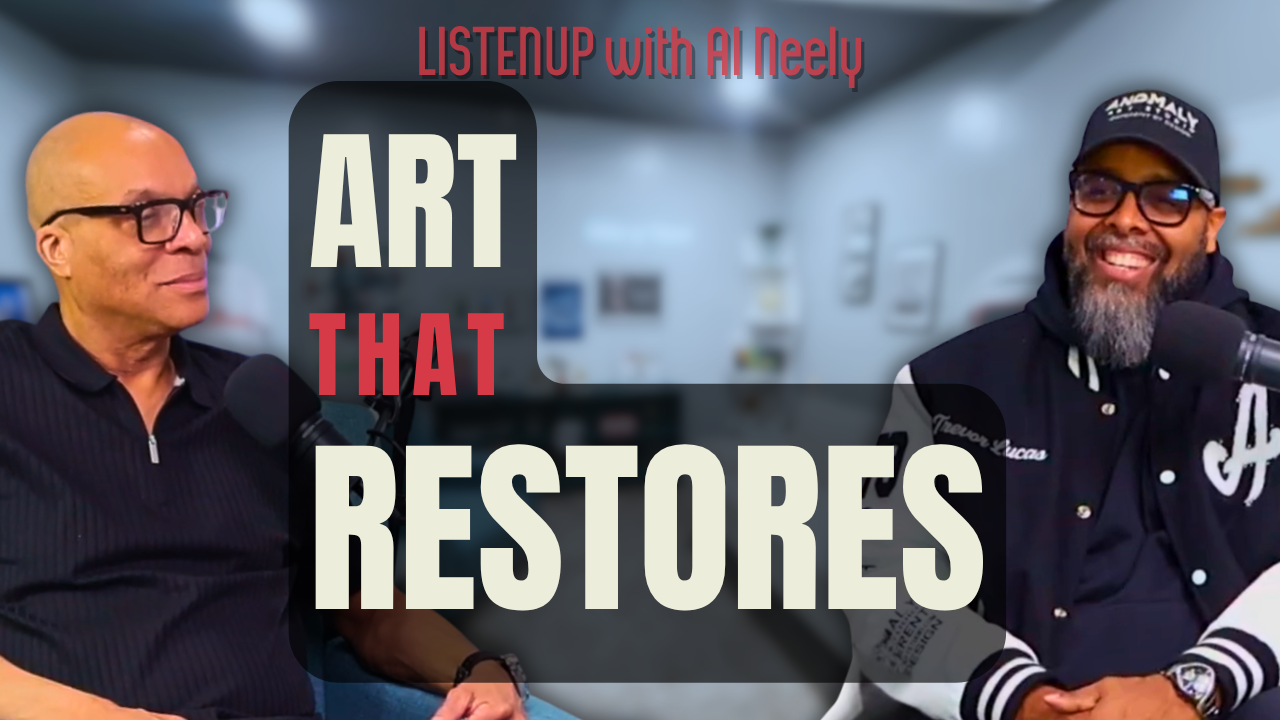
Art that restores Trevor Lucas’s work shows how public art can carry history, spark connection, and help communities heal. In this episode of ListenUp with Al Neely, Trevor Lucas, founder of Anomaly Art Studio, shares how murals become tools for identity, representation, and restoration.
Watch the Full Episode:
In this episode with Trevor Lucas, Art that Restores, we discuss:
- Trevor Lucas’s journey from Louisiana to Virginia and the roots of his creative life
- Founding Anomaly Art Studio and building a career in public art
- Why faith shapes his decisions as an artist, husband, and father
- The winter production grind behind the Sentara “Community Care” murals in Newport News
- The history embedded in those murals, including Black physicians, Smith Pharmacy, and a Black-owned funeral home from the 1930s
- His “I Am Virginian” mural at Busch Gardens and the importance of broad representation
- Trauma, addiction, and the near-fatal burglary that changed his life at 15
- Healing, forgiveness, and reconciling with family
- Why unresolved pain can shape adult anger and hypermasculinity
- War Paint, his group art-therapy work focused on recovery, identity, and healing through guided imagery and conversation
Art that restores begins with people, not paint.
In this episode of ListenUp with Al Neely, Trevor Lucas explains how murals can do more than brighten public space — they can preserve history, widen belonging, and help communities see themselves with greater dignity. As the founder of Anomaly Art Studio, Trevor brings a perspective shaped by faith, hardship, and a deep commitment to service through art.
Public art as community memory
Trevor’s work shows that public art is not just visual decoration. It can act as a form of memory. In the conversation, he reflects on the Sentara “Community Care” murals in Newport News, where the artwork carries references to Black physicians, a historic community hospital, Smith Pharmacy, and a Black-owned funeral home from the 1930s. These details matter because they turn a wall into a story people can return to.
In this episode, you’ll hear about:
- Murals as a way to document local history
- Why representation matters in public-facing art
- The challenge of producing large outdoor work in winter weather
- How artists balance creative vision with community responsibility
Faith, identity, and creative decisions
Trevor also speaks about faith as a daily practice rather than a slogan. That perspective shapes how he approaches conflict, marriage, fatherhood, and leadership. His creative lens is rooted in service: judge by fruit, love with courage, and let the work help people first. That mindset gives the episode a strong moral center without flattening the complexity of his life story.
Art, trauma, and healing
One of the most powerful sections of the episode focuses on Trevor’s personal journey through abuse, addiction, and a near-fatal burglary at age 15. He reflects on detox at a boys’ home, his time in the Navy, and the ship murals that first affirmed his gift. Those experiences shaped his understanding of pain, purpose, and forgiveness. He also speaks candidly about reconciling with his father and stepfather, and why unresolved childhood wounds often reappear later as rage or hypermasculinity.
War Paint and the power of guided expression
The conversation closes with War Paint, Trevor’s group art-therapy initiative. He describes it as a space where guided images, such as breaking shackles, combine with honest discussion about recovery and identity. The goal is not just self-expression, but possibility — giving people something to see so they can imagine a different version of themselves. That makes this episode especially strong for listeners interested in community healing, trauma recovery, and culture-building through creative work.
Why this episode matters
This episode matters because it shows that art can carry responsibility. Trevor Lucas treats public art as a tool for memory, dignity, and restoration — not just aesthetics. His story connects creativity with faith, identity, healing, and the kind of leadership that leaves a mark on both walls and people.
About ListenUp with Al Neely
ListenUp Podcast features conversations across creativity, culture, and community, with guests whose stories help listeners think more deeply about how people grow, lead, and heal.
Episode Transcript (Edited for Readability)
Al Neely:
Welcome to ListenUp Podcast. Today we’re talking with Trevor Lucas from Anomaly Art Studio about public art, community restoration, and the stories murals can carry.
Trevor Lucas:
Art can do more than make something look better. It can help people feel seen. It can hold history, identity, and hope in one space.
Al Neely:
A lot of your work is rooted in community. What drives that?
Trevor Lucas:
I want the work to serve people first. A mural should say something honest about who belongs there and what that place has lived through.
Al Neely:
You also talk openly about trauma and healing in this episode.
Trevor Lucas:
I’ve been through abuse, addiction, and violence. Those things shape you, but they don’t have to define the final version of you. Art gave me a way to process and rebuild.
Al Neely:
And that connects to War Paint too.
Trevor Lucas:
Yes. War Paint is about giving people guided images and real conversation so they can see new possibilities for themselves. Sometimes people need to see freedom before they can believe in it.
Related Episodes:
Share This Story, Choose Your Platform!
LISTEN NOW